
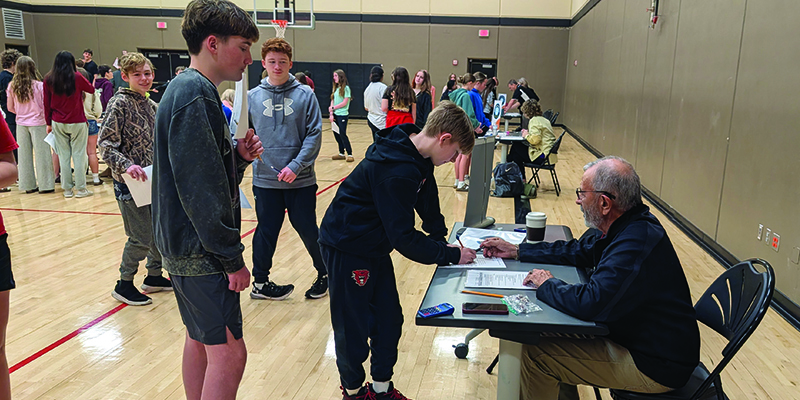
El Dorado Middle School eighth grade students participated in a Future Now Finance event on Mar. 10, 2026.
This finance simulation provides students with a hands-on experience in understanding the realities of preparing for a successful future and adulthood. They explore budgeting and balancing expenses based on career income and family size while covering all of the essentials to live independently.
Before the event, students received a profile that outlined whether they were married, had any children, what level of education they had achieved, what their career was, and how much net income they had each month after taxes were withheld.
With profile and transaction log in hand, students entered the gym and began visiting each of the booths to decide where and how to spend their income. Some of the booths such as the housing/utilities were required, while others such as charitable giving or entertainment were optional.
There were 11 stations total, staffed by community volunteers: charitable giving, entertainment, communications, healthcare, banking, housing/utilities, financial advising, child care, transportation/insurance, and chance. At the chance booth, students could roll the dice and either had their income supplemented by something like coupons or overtime, or depleted by a speeding ticket or unexpected visitors.
While half of the eighth graders were learning the tough realities of living within a budget, the other half were listening to guest speakers.
Butler Community College Director of Admissions Kirsten Allen spoke to students about some of the programs and services Butler has to offer. She talked about the biggest differences between technical colleges, community colleges, public universities, and private colleges. She explained how students can save money by starting at a two-year college like Butler to get their general education credits completed before transferring to a four-year college to earn a Bachelor’s degree.
The other guest speaker was Jennifer White from ICTSOS, a non-profit organization that provides training and awareness, advocacy and therapy for adult victims, and resource coordination to try to bring an end to human trafficking.
White defined human trafficking as the buying and selling of people, with two key components: exploitation and exchange of value. The two main types are labor and commercial sex. She encouraged students to be aware of their surroundings, but keep in mind that most human trafficking is not random kidnapping. Human traffickers build a relationship first, then use trickery, force, or threats to gain compliance from their victims.
After watching a short scenario, she asked students to identify if the situation was human trafficking. It was not. In the scenario, there was no exchange of value, so it was online exploitation. She stressed that while it did not meet the definition of human trafficking, it was still a crime and should be reported.
White advised students not to send inappropriate photos to each other and let them know it is illegal to have or share those types of photos.
“Be a good support for each other,” White said. She emphasized the importance of empathy and positive support if a friend confides in them that they are in a human trafficking or online exploitation situation. While using a platform’s built-in reporting tool is always a good first step, she told students to go a step further and report the incident to a trusted adult or tip line such as Take It Down or Cyber Tipline.
ICTSOS also has a mobile app available that shares red flags, warning signs of human trafficking, reporting tools, and links to resources to help victims.