
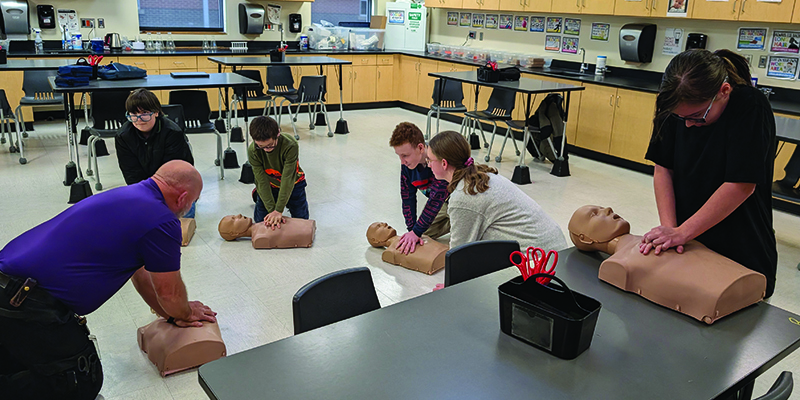
Students at El Dorado Middle School recently learned skills that could help save a life. On Feb. 4, 2026, Stuart Funk from Butler County Emergency Medical Services visited Project Lead the Way – Medical Detectives classes taught by Dawn Gwinn. He taught students how to perform high-quality, hands-only CPR and how to use Automated External Defibrillator (AED) machines.
Funk has worked with Butler County EMS since 2002 and has led CPR training since 2014. He shared the importance of the lesson and survival rate statistics.
"I'm here to arm you with the skills that could save a life someday," Funk said.
CPR stands for Cardiopulmonary Resuscitation. “Cardio” means heart, “pulmonary” means lungs, and “resuscitation” means reanimation. CPR involves pushing on someone’s chest to help move oxygen-rich blood from the heart to the rest of the body. During cardiac arrest, the heart may still have electrical activity, but it is not circulating blood effectively.
Each year, about 350,000 to 380,000 people experience cardiac arrest outside of a hospital setting. Nationally, only about 10 percent survive and are able to function afterward. In Butler County, 16 percent of the 77 people who suffered cardiac arrest outside of a hospital last year survived. The goal of CPR training and increased access to AED machines is to raise the number of people who survive and recover.
Funk explained that people often hesitate to help because they do not know what to do, are afraid of hurting the person, or worry about being sued. He emphasized that cardiac arrest can happen to anyone at any age. Since 2017, the youngest survivor of cardiac arrest in Butler County was just 6 days old. Their grandmother called 911 and performed CPR until paramedics arrived. The grandmother’s quick action saved the child’s life.
Time is critical in an emergency. For every minute without help, a person’s chance of survival drops by 7 to 10 percent. After 10 minutes without intervention, there is almost no chance of surviving and being able to function.
Students learned how to recognize when CPR is needed. A common sign of cardiac arrest is collapse. Cardiac arrest is not the same as a heart attack, although a heart attack can cause cardiac arrest. CPR should begin when a person is unresponsive and not breathing. Rescuers should shake the person’s shoulder, ask if they are okay, and check for breathing by placing a hand lightly on the chest for five to ten seconds. If the person is not breathing, 911 should be called and placed on speaker phone. Someone nearby should be asked to retrieve an AED if one is available.
Funk demonstrated proper hands-only CPR technique. Rescuers place the heel of one hand in the center of the chest on the sternum, with fingers facing the armpit. The second hand goes on top, fingers interlocked. Elbows should be locked, with shoulders positioned over the hands. Compressions should be at least two to three inches deep and performed at a rate of 100 to 120 compressions per minute. Compressions should continue for two minutes at a time, switching on and off with a partner if possible.
Students also learned about AEDs, which stands for Automated External Defibrillator. An AED is a machine designed to stop the heart using an electrical current so it can return to a normal rhythm. Funk explained that cardiac arrest does not mean the heart has completely stopped beating—it means the heart is not circulating blood.
An AED checks for four different heart rhythms. Two are shockable rhythms: ventricular fibrillation, when the heart is quivering, and pulseless ventricular tachycardia, when the heart is beating too fast to circulate blood. Two rhythms are not shockable: pulseless electrical activity, when electrical signals are present but the heart muscle is not moving, and asystole, also known as flatline, when there is no electrical or mechanical heart activity.
To use an AED, the machine should be brought to the person and turned on, following the spoken instructions. Adult AED pads can be used on children and infants if needed, but child or infant pads should not be used on adults because they do not deliver enough shock to be effective.
The AED will instruct rescuers to remove clothing from the chest so the pads can be placed directly on the skin. Sometimes clothing may need to be cut off. The pads are placed according to the diagram on the machine, with one pad on the upper right side of the chest and the other on the lower left. If two people are present, one should continue CPR while the pads are applied.
When the AED is ready to analyze the heart rhythm, no one should touch the person. If a shockable rhythm is detected, the machine will advise a shock. If a shock is advised, the AED will charge and instruct the rescuer to press the button to deliver the shock after making sure no one is touching the person. The machine will then tell rescuers when the shock has been delivered so they can immediately resume chest compressions.
By learning CPR and AED use, El Dorado Middle School students are gaining confidence and knowledge that could one day help them save a life.